Thursday, August 28, 2014

Pentax K-S1 DSLR camera

Pentax-K-S1-camera-front
Pentax-K-S1-camera-back
Pentax-K-S1-camera-top

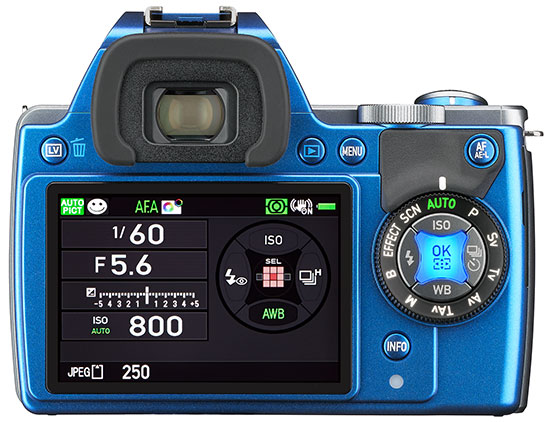
The previously rumored 20MP/5.3 fps Pentax K-S1 DSLR camera with LED lights is now officially announced. For pricing, availability and color choices check B&H and Adorama.


Additional K-S1 information:
Illuminated Interface for intuitive camera operation
The PENTAX K-S1’s power switch, mode dial, OK button and grip all feature LED illumination; each of which indicates the current status of camera operation. The LEDs for the power switch, for instance, stay green during still-image shooting, but change color to red during movie recording. When the Face Detection function is activated, the number of LEDs illuminated on the grip corresponds with the number of faces that have been detected. The grip LEDs also act as a countdown timer during self timer operation. This LED body illumination gives a decorative illumination to the choice of distinctive body colors; furthering the look of the camera as a sophisticated digital device.
Compact, lightweight body with distinctive design
The K-S1 camera body’s main chassis, including the grip, is designed to be compact in size and sophisticated in appearance, while the pentaprism employs a solid, time-proven design that easily matches high-grade SLR cameras. By harmonizing these dissimilar elements, the K-S1 delivers a body design that is totally original and remarkably fashionable.
High-resolution images produced by the 20.12 megapixel CMOS sensor with a super-high sensitivity of ISO 51200
The K-S1 is equipped with a newly developed CMOS image sensor with approximately 20.12 effective megapixels to deliver super-high-resolution images. It is also designed without an optical AA (anti-aliasing) filter to optimize the imaging power of the sensor. By coupling this image sensor with the high-performance PRIME MII imaging engine, the K-S1 delivers true-to-life, detailed images by effectively minimizing noise at all sensitivity levels, even during super-high-sensitivity shooting at ISO 51200.
In-body shake reduction (SR) mechanism, and AA (anti-aliasing) filter simulator for effective moiré reduction
(1) In-body SR (Shake Reduction) mechanism
The K-S1 features the PENTAX-developed SR (Shake Reduction) mechanism to effectively minimize camera shake and assure sharp, blur-free images, even in camera-shake-prone conditions such as when using a telephoto lens, shooting low-light scenes with incident light only, or photographing sunset scenes.
(2) Innovative AA (anti-aliasing) filter simulator*
By applying microscopic vibrations to the image sensor unit at the sub-pixel level during image exposure, the K-S1’s AA filter simulator provides the same level of moirĂ©-reduction effect as an optical AA filter. Unlike an optical AA filter, which always creates the same result, this innovative simulator lets the user not only switch the AA filter effect on and off, but also adjust the level of the effect
(3) ASTRO TRACER support
The K-S1’s SR unit has a flexible design that shifts the image senor horizontally (left/right), vertically (up/down), and rotationally. Taking advantage of this flexibility, the K-S1 provides a host of handy shooting functions, including ASTRO TRACER, which simplifies advanced astronomical photography in combination with the optional GPS unit, O-GPS1.
* This function is most effective with a shutter speed of 1/1000 second or slower. This function is not available during HDR (High Dynamic Range) shooting.
Optical viewfinder with 100-percent field of view
The K-S1 is equipped with a glass pentaprism finder featuring the same optics and coatings as those used in higher-level models. It assures the highest level of viewfinder brightness in its class, with a magnification of approximately 0.95 times to provide a broad image field for easy focusing and framing.
High-speed shutter to capture fast-moving subjects in crisp focus
The K-S1 provides a top shutter speed of 1/6000 second to capture the decisive moment. Coupled with its high-speed continuous shooting function (with a top speed of 5.4 images per second), it lets the photographer freeze once-in-a-lifetime shutter opportunities.
High-precision AF with SAFOX IXi+ AF sensor module
The K-S1 features the SAFOX IXi+ AF sensor module, which assures responsive, high-precision autofocus operation with 11 sensors, including nine cross-type sensors. It also provides a spot beam to assist AF operation in poorly lit locations. Its select-area expansion function ensures that the sensor module keeps tracking a moving subject, even when the subject moves out of a pre-assigned auto-tracking area, by assessing the distance data collected by neighboring focus sensors. The AF hold function maintains the in-focus position, even when the AF system loses track of the subject after once capturing it in focus. These functions combine to improve the camera's accuracy in the detection of moving subjects when its focus mode is set to AUTO, and upgrade its auto-tracking performance of these subjects when using a telephoto lens.
A selection of image-processing tools for creative, personalized expressions
By setting the Mode dial to the EFFECT position, the user can apply the desired visual effect to an image while previewing the outcome on the LCD monitor. It provides a choice of 10 distinctive effects, including three new options: “Fresh” with a crystal-clean finishing touch; “Fade Color” for an elegant finish with subdued colors; and “Infrared” for a black-and-white finish like that of an infrared photo. The K-S1 also provides 21 digital filters (nine of them applicable during shooting), including a new “Color Replacement” filter.
Dependable lens aberration compensation system
In addition to the effective compensation for distortion, chromatic aberration and peripheral brightness, the K-S1 also provides compensation function for diffraction, which deteriorates image resolution when a small aperture is used.
Connected device functions**
The optional FLUCARD FOR PENTAX 16GB memory card can release the K-S1’s shutter, provide a live-view image, and browse and download the images recorded on the card using a smartphone or other wireless and web browser enabled device.
** These functions support smartphones operating iOS6 or later and Android 4.2 or later.
3.0-inch, high-resolution LCD monitor, and newly designed, easy-to-use interface
The K-S1 features a high-resolution, wide-view LCD monitor with approximately 921,000 dots. It also provides a status screen employing the newly-designed GUI (Graphical User Interface), which allows the user to confirm functions and settings assigned to the four-way controller and the OK button at a glance. The RICOH RT font has been used for on-screen menus to improve readability.
Full HD movie recording with stereo audio
The K-S1 captures beautiful Full HD movie clips (1920 x 1080 pixels; 30/25/24 frame rate) in the H.264 recording format, which assures flawless, high-quality movies even with fast-moving subjects. It is also equipped with a built-in stereo microphone for recording natural sound during Full HD movie recording.
Color Options
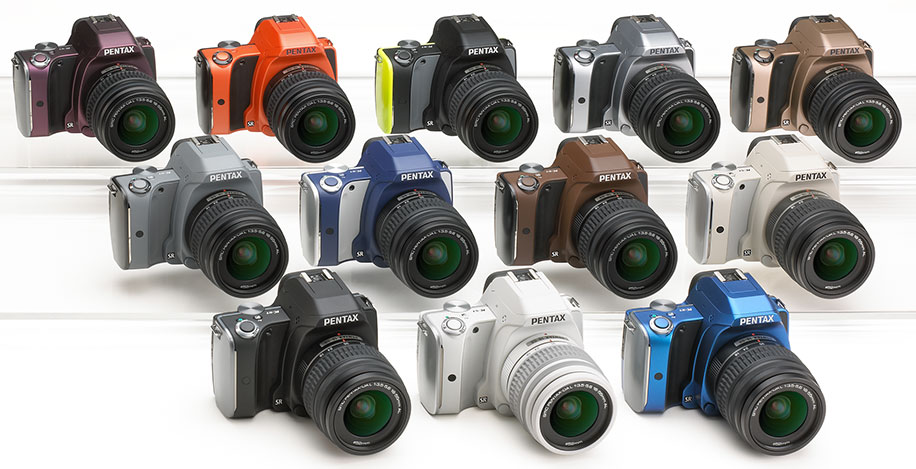
The K-S1 comes in 12 different colors: The standard colors: black, blue, and white. The Fabric Collection: Cotton Beige, Linen Brown, Denim Blue, and Tweed Gray. The Night Sky Collection: Sunset Orange, Dusk Gold, Moon Silver, Midnight Black, Dawn Purple.
Other features
・ Compatible with Eye-Fi wireless LAN memory cards
・ 77-segment, multi-pattern metering system for high-precision light measurement
・ DR (Dust Removal) mechanism for effective elimination of dust on the image sensor using ultrasonic vibration
・ Digital Camera Utility 5 software (latest version) included
Pentax-K-S1-camera-all-colors
Press release:

Ricoh Imaging Debuts an Innovative User Interface Attracting Mid-Level DSLR Camera Buyers to PENTAX Brand

Denver, Colorado August 27, 2014 – Focused on expanding the number of PENTAX DSLR owners, RICOH IMAGING AMERICAS CORPORATION is excited to announce the launch of the PENTAX K-S1 DSLR camera. By combining proven imaging technology, distinct design cues and a flat field user interface (UI) the K-S1 appeals to the next generation PENTAX owner without surrendering the performance expected in a mid-class camera.
Building on the many technologies benchmarked in the company’s popular K-3 advanced DSLR; the K-S1 incorporates a newly designed 20 megapixel image sensor, super-high sensitivity ISO 51200. In addition this model contains in-body shake reduction, an AA filter simulator, 100% field of view glass pentaprism viewfinder, and 5.4 frames per second shooting at a fast 1/6000 shutter speed. Adding to the user experience is the camera’s unique flat field user interface, which integrates a back-lit LED selection dial, four-way navigation, and a bright 3” 921,000 dot LCD that breaks tradition of the knobs and buttons found on traditional DSLR cameras.
The PENTAX K-S1 is designed to attract a mid-level customer who is accustomed to a mobile interface and is looking for a similar interaction in a DSLR. The simple UI eliminates many of the complexities of a DSLR and provides immediate feedback including shooting parameters, filter selection and effect modes, even in total darkness. The camera’s power switch, mode dial, OK button and grip all feature LED illumination; each of which indicates the current status of camera operation. This intuitive UI and design combined with category leading technology delivers a powerful imaging engine that is simple to use.
“With the K-S1 we are building on our solid reputation as a camera company and inviting new customers to experience the PENTAX advantage” said Jim Malcolm, Executive Vice President, Ricoh Imaging Americas Corporation. “Our core PENTAX products provide an important foundation that the K-S1 builds upon.”
The optional Flucard for PENTAX offers additional features such as Wi-Fi transfer, wireless live view, and Remote Capture control; letting users take control of their camera settings with a smartphone, tablet, or computer and save images directly to a mobile device.
The K-S1 comes in 3 standard colors: black, blue, and white. In addition, two separate color collections are available; The Fabric Collection, containing 4 unique colors such as cotton beige and tweed gray – and the Night Sky Collection, with 5 more elegant colors like Sunset Orange, Dawn Purple, and Midnight Black.


Read more on PhotoRumors.com: http://photorumors.com/2014/08/27/pentax-k-s1-dslr-camera-with-fancy-led-lights-officially-announced/#ixzz3BhNudQI7

Thursday, July 3, 2014

The 3 DSLR Lenses You Need and 2 More You'll Crave

AND
The 3 DSLR Lenses You Need (and 2 More You'll Crave)EXPAND
This goes out to people who bought or want an entry-level DSLR, and wonder what's the deal with interchangeable lenses. You really gonna buy that extra glass? It's a beginner's guide to growing as a photographer, preferably without going broke.
It doesn't matter what brand of camera you bought—if it's an entry-level DSLR, it was offered to you with an 18-55mm kit lens. I hope you took them up on that offer because no matter what you bought, that kit lens comes cheap, and is well worth it. Yes, of the five lenses covered here, that kit lens is numero uno.
KIT LENS
Like most bundle pricing, it's cheaper than buying the camera body and lens separately, and most experts agree that an 18-55mm is actually the perfect lens for most immediate photographic needs, with both a decent wide angle plus the ability to zoom in on far away objects. In fact, if you take a look at the four shots below—all taken by me with kit lenses on basic DSLRs—you can see a foreshadowing of the four other lenses in this briefing—telephoto, wide-angle, portrait and macro:
But if you read Gizmodo enough, you know that we've made the case that lenses, and not the cameras themselves, account most for great pictures. Photography is an optics game first and foremost, and there's a point at which that kit lens can't achieve shots that your heart and soul tell you are achievable. There's nothing wrong with your camera—seriously, there's nothing wrong with it. You just need to get some more lenses.
In order to run this story I called some experts at Canon, Nikon and Sigma, which makes discounted lenses for most DSLRs. I could have called experts at [insert your favorite non-Canon or Nikon camera brand here] but early on, the advice was consistent and clear: Anyone who is really taking an interest in their camera should invest in a telephoto zoom next, followed by a fast "normal" lens, which you might call a portrait lens.
LENS LABELING
In the interest of speed, I can't talk about lens anatomy, but there are some key attributes you need to know to read all lens retail listings: focal length and aperture.
In most cases, the lens categories here differ by the focal length, that is, how close a subject appears, indicated in millimeters. The human-eye equivalent is between 30mm and 50mm. A telephoto lens, which gets up close to things that are far away, can be as long as 500mm. A wide-angle lens, which makes close-up objects appear farther away, can be 10mm—still less if you want the bulbous fisheye look. A "zoom" lens simply means that it has a variable focal length—for instance, your kit lens, which can hit any length from 18mm to 55mm.
The 3 DSLR Lenses You Need (and 2 More You'll Crave)EXPAND
Because entry-level cameras have smaller (APS-C) sensors than professional APS) full-frame 35mm cameras, everybody makes two sets of lenses. Typically all lenses work on beginner cameras, but beginner lenses don't work on pro cameras. If you stick with beginner lenses (denoted Nikon DX, Canon EF-S, Sony DT, Pentax DA, Sigma DC and Tamron Di II), you won't have to stress, but if you want to buy a pro lens, or have some lying around, bear in mind that you need to multiply the focal length by 1.5 or so to get the equivalent focal length for your camera. A 50mm pro lens is really a 75mm lens on your beginner's model. Why am I telling you this? Because there are new and used pro-level lenses out there for really good prices.
The 3 DSLR Lenses You Need (and 2 More You'll Crave)EXPAND
In one case below, what sets the lens apart is its large aperture. The aperture is the hole that lets in the light, and it's measured by the f-stop. A wider aperture means more light comes in, and you have a better chance of getting nice shots indoors, in dimmer settings. A narrower aperture lets in less light. The trade-off is that a wide aperture can't focus on as many things that are at different distances—it is said to have a "shallow depth of field." Your main subject is clear, but the background is blurry—artistic in many cases, annoying in some. When you narrow the aperture, you can crisply resolve more elements, but only if there's enough light. The wide aperture of a "fast" lens can always be narrowed, but there's no way for a "slow" lens with a narrower aperture to bring in more light.
As if that wasn't tricky, check this out: The f-stop is a fraction, and the number you refer to is on the bottom, so if it's low (f/1.4), the aperture is wide, and if it's high (f/6.0), the aperture is narrow. Got it? Zoom lenses at beginner prices tend to have variable f-stops, apertures that get narrower, and in need of more light, as you zoom in.
TELEPHOTO ZOOM
Lenses in many ways are about reach, about bringing faraway subjects closer to your camera's sensor. "The low-end customer, who may take out their DSLR only occasionally, says, 'I want to shoot a picture of the moon, or animals at the zoo, or kids playing soccer,'" says Dave Metz, a lens specialist at Sigma. Even when that kit lens is cranked to the max, it's only giving you a 55mm focal length, which is why most DSLR makers have a very well-priced 55-200mm lens waiting at the ready. Prices range from $120 to $250, and it's usually the easiest purchase to make.

Credits: Lindsay Silverman - Nikon; me with Nikon; Robert O'Toole - Sigma; Stephen Lang - Sigma
Another telephoto zoom lens you'll see is the 18-200mm, which can cost anywhere from $350 to $600. That's a hefty premium to pay just so you don't have to schlep around two lenses, and generally speaking, the broader the focal length range, the more corners are being cut in performance. That lens is a pass.
If you are feeling particularly far out, both Metz and Nikon's camera marketing guru Steve Heiner suggest a 70-300mm lens. Sigma's model sells for under $200, Nikon's most recent model, with built-in image stabilizing, is just over $500, and there are 70-300mm lenses for everyone else ranging from $130 to $850, all with variable f-stops of either f/4.0-5.6 or f/4.5-5.6. Better yet, these lenses are spec'd for pro-grade full-frame cameras, so they're exceptionally zoomy on your beginner's camera, more like 105-450mm. Hey, don't think about it too much, just enjoy it.
NORMAL (AKA PORTRAIT)
As much traction as you'll get from a zoom lens, it doesn't really teach you much, except maybe how to compose without cropping. I personally learned a hell of a lot more about photography when I started playing with f/1.8 50mm lenses. This is called a "normal" lens because, says Heiner, "It was all you could get on a camera in the '50s and '60s." In fact, he jokes that even though younger people are snapping up this relatively cheap lens ($100 to $150), he and his ilk "couldn't wait to get away from it" when zoom lenses started hitting the market.
What does it do? As a "fast" lens, it can shoot really well in low light. Keep the aperture wide, get up in your subject's grill, and start clicking. You'll see parts of their face sharply resolved while other parts are softly blurred. Tighten the aperture a tad, and your subject's whole head is clear while the backdrop is soft and peaceful, even if it's a Manhattan street corner at rush hour. What doesn't it do? It doesn't zoom, and because it's usually rated for pro cameras, it's about the equivalent of 75mm on an entry-level DSLR—which is roughly the preferred focal length for portrait shooting—so you often have to step back to get a decent shot.

Credits: Me with Canon; Joe DiMaggio - Sigma; Joe DiMaggio - Sigma; Lindsay Silverman - Nikon
Alternatives to the cheap f/1.8 lens are an even faster one, f/1.4 ($300 to $500), or a 30mm or 35mm that gives entry-level cameras more of a "normal"—what your eye can see—perspective.
At this point, in addition to the original cost of your camera, you've spent less than $500, and you've added immeasurable functionality and artistic wiggle room. You can stop here, and you won't be judged. But, if you like, I can tell you about two more lenses that might rock your casbah.
ULTRA-WIDE ANGLE ZOOM
That kit lens brings you down to 18mm, which is enough for you to stand in a corner of a room and shoot pretty much anything going on in that room. But what if you're not in the corner?The same twist of fate that makes pro-level telephoto lenses even more zoomy on your entry-level DSLR makes wide angles trickier—or at least more expensive—to attain.
Why is this? Film is flat, so light can come in at any angle, and the film will mostly record it. But camera sensor pixels are concave, and don't do well with light coming in from the side. Think of the pixels as little water glasses, says Sigma's Dave Metz. "You can fill them up with water by pouring it in from above, but try shooting it in from the side with a garden hose, and it's going to go all over the place." A telephoto by definition is pulling in light from directly in front of it, whereas a wide angle by definition is bringing in light from the sides, too. Hence the trouble, and the added expense.
But if you have the means, it's the consensus of my experts that you should pick yourself up an ultra-wide-angle zoom lens (10-24mm, 10-22mm or 10-20mm). Just be very careful that it's one built specifically for entry-level DSLRs, with the arcane designations I mentioned in the "Lens Labeling" section. Discounted on Amazon, Nikon's is selling for $809 while Canon's is around $730. Tamron and Sigma make them for Canon and Nikon for just under $500.

Credits: Stephen Lang - Sigma; David FitzSimmons - Sigma; Carol Polich - Sigma; Joe DiMaggio - Sigma
And the aesthetic pay off? As Metz tells it, "I am sure you've seen a beautiful mountain scene; in the foreground there's beautiful little flowers. Because they're so close, they appear out of perspective. You effectively enlarge the flowers." It's also, as he points out, the best way to make sure that all the uncles and aunts are included in the family portrait you take at the Christmas dinner table.
MACRO
The final stop on our survey of lens-topia is the macro—or big hairy bug—lens. "When I try to show people about macro photography, they say 'What is that?'" says Lisette Ranga, a Canon camera marketing specialist, "but when they look through the viewfinder, and see how close you can get, they get it." While I don't understand why people like taking pictures of bugs and flowers so much, I am a victim of the chronic urge to do so. Though some are 50mm or thereabouts, many macros are telephoto lenses. The ideal, it seems, is to shoot stuff up close that you wouldn't even want to get near—he who snaps the most snakes and scorpions wins.

Credits: Canon 60mm Macro sample; Canon 60mm Macro sample; David FitzSimmons - Sigma; Lindsay Silverman - Nikon
So what do you look for? Typically, macro lenses have a fixed aperture of f/2.8 (sometimes f/2.5). Sigma has five lenses, ranging from 50mm ($300) to 180mm ($900), all fixed, plus a few zooms such as the one I personally want to try out, the 24-70mm ($570, compared to well over $1,000 for the equivalent Canon or Nikon). What's cool is that when you're not photographing scorpions (or stamps or coins or documents), you can use these for portraits and other "normal" shooting, but with such sharp resolve that some even recommend a bit of digital softening.
So you see, adding those final two lenses more than doubles your investment, and for a diminished payoff. That's what you would buy next, but for most of you, it's not what youshould be buying.
IMAGE STABILIZATION, LENS MOUNTS AND YOUR DADDY'S LENS COLLECTION
Though some readers probably gave up on this story a long time ago, I have made every attempt to keep it clear and moving. In doing so, I skipped over lots of hot topics, including image stabilization and lens compatibility.
Canon and Nikon currently promote the hell out of image stabilizing lenses, in large part because their cameras do not have in-camera image stabilization like Sony, Pentax and Olympus. While image stabilization does tend to matter, its location doesn't seem to matter as much. The consensus on the internet is that it's a drag to have to buy IS in lenses over and over, and from what I've seen, there is a clear added cost when buying lenses a la carte. Nevertheless, there's a premium for buying Nikon and Canon because they are consistently the best reviewed and the biggest sellers, so there's no right or wrong. It's just something to look for when buying lenses, and to discuss with your favorite camera nerds.
The main reason Canon and Nikon don't have IS in their cameras is that the camera technologies pre-date the digital revolution, and it was harder to do with film. The flipside is this: Older film-based lenses from Canon and Nikon work on newer Canon and Nikon digital cameras. For Canon, it's the EF standard, which dates back to 1987. If the lens says EF on it, it will work. If it says EF-S, it was specifically made for entry-level DSLRs, and won't work on pricier pro models. If you put an EF lens on a camera that typically takes EF-S lenses, remember to multiply by 1.6 to figure out the real focal length.
For Nikon, it's a tad weirder: Any F-mount lens dating back to 1959 will fit on the thing, but only the lenses labeled AF-S will definitely work with D40/D60/D90/D3000/D5000 class of entry-level DSLRs. If the lens doesn't say "DX" on it, multiply the focal length by 1.5 to see what it really is. If your dad hands you a bag of Nikon lenses, accept them graciously, and try them all out, but be ready for weird results, or at the very least, a sudden lack of autofocus and auto metering.
LENS QUALITY
I want to leave you with one final bone of contention—the quality of the lenses. I recognize that I have made many suggestions that seem like go-out-and-buy-'em recommendations. I do think that shopping for new lenses on a tight budget is a good way to expand as a photographer, but this is not a "buyer's guide."
Many photography enthusiasts believe buying a cheap lens to attach to your camera would be like buying a used prophylactic to... well, I'll spare you the imagery. But the point is, there is surely a reason why third-party ultra-wide-angle zoom lenses cost half as much as big name versions, just as there is surely a reason why Canon's 50mm f/1.4 costs nearly four times as much as its 50mm f/1.8. There are real differences in lenses, and I'm happy to invite you to discuss them below.

Sunday, June 8, 2014

:+: Best DSLRs 2014 :+:

Nikon D3300

Best DSLR for Beginners

Replacing Nikon's popular D3200, the new D3300 offers intermediate-level performance with a beginner-friendly design and price. It shoots sharp 24.3-megapixel images and smooth 1080p video at a top-performing 60 frames per second — capabilities comparable to those of cameras costing hundreds more. Detail in photos is exceptional: We could read a tiny plaque on the corner of a house shot at a wide angle. Colors are not only rich, but faithful to how they appear in real life. There are some compromises for the price. The camera's 3-inch, 921K-pixel LCD does not tilt or rotate, and is not a touch screen. The D3300 also doesn't offer some of the advanced controls more expensive cameras have, but all the key settings are easy to access.

The optional 18-55mm lens is smaller and lighter than its predecessor and collapses to make the camera even easier to transport. The lens produces little distortion, but the D3300 can capture better images with even slightly higher-end glass. Being a Nikon, this DSLR has access to hundreds of lenses, allowing the camera's capabilities to grow as yours do.


Canon EOS Rebel T5i

Best Intermediate DSLR

If you’re familiar with f/stops, white balance and ISO and want to trade in your years-old DSLR for the latest tech, get the 18-MP Canon EOS Rebel T5i with an 18-55mm STM zoom lens. That "STM" stands for silent stepping motor. Now, when the camera autofocuses as you’re recording a video, the camera mics won’t pick up the noise of the lens moving. This is very important if you’re capturing a quiet scene.

Other standout features of the T5i include shooting 5 photos per second in burst mode and providing light sensitivity up to ISO 25,600 for shooting in very low light. Video recording is up to 1080p HD at 30 fps with stereo sound from built-in microphones. There are manual audio adjustments and a jack to connect an external mic, as well. Movie quality is quite good at 1080p/30 fps, but it’s not as good as the 1080p/60 fps of some competing cameras, such as Sony’s. One final bonus: Canon offers nearly 100 lens choices.


Canon EOS 70D

Best Enthusiast DSLR

Those serious about taking their photography or video to the next level will love Canon's EOS 70D ($1,350 with 18-55mm EF-S IS STM kit lens). The 20-MP camera packs a CMOS imaging chip with "dual-pixel" focus technology incorporating fast phase-detection pixels into 80 percent of the sensor to speed up autofocus when shooting in live view mode (framing images on the LCD). In addition, a 19-point autofocus system in regular shooting mode, a top shutter speed of 1/8,000 sec (versus 1/4,000 for most other DSLRs) and an ISO light sensitivity range of up to ISO 25,600 make the 70D a versatile shooter for almost any situation, day or night.

When shooting video, the dual-pixel sensors lock focus on the subject you designate, keeping it sharp regardless of where it moves. This is the first DSLR autofocus technology comparable in accuracy to a skilled videographer using manual focus, making the 70D a superb rig for aspiring filmmakers. A flip-out, tilting 3-inch LCD touch screen lets you compose still and video at a variety of odd angles, and an LCD readout on the top lets you quickly check and adjust your settings. The EOS 70D is compatible with Canon's 103 EF lenses, plus many third-party lenses, to cover any shooting situation. 


Nikon D800

Best Professional DLSR

You can spend well north of five grand for pro DSLRs such as the Nikon D3X or Canon EOS-1 Dx, but those behemoths are really for photo studios and professional sports coverage.

The Nikon D800 ($2,999, body only) has the same key feature of higher-priced competitors: a so-called full-frame imaging sensor that's the same size as a frame of 35mm film. The D800's massive sensor allows it to capture wider-angle shots than lower-end DSLRs and affords it a whopping 36.3-MP resolution — the highest for any full-frame DSLR.

The color accuracy is outstanding, and it captures the finest details. The D800 also captures full HD videos at 1080p/30 fps in the high-quality AVC format, which can directly output via HDMI to external recording devices for further editing.

Although quite hefty due to its dust- and moisture-sealed magnesium alloy body, the D800 is not intimidating. All the controls are clearly marked and within easy reach. This is one photographic tool that will take time to completely master, but while you’re “playing,” you’ll capture some of the best images you’ve ever seen from a digital camera.


Sony Alpha a77 II

Best Action DSLR Candidate

The latest salvo in the autofocus war, the new Sony Alpha a77 II shoots 12 frames per second for up to 5 seconds. That makes it one of the fastest DSLRs on the planet and by far the fastest anywhere near this price. (The Canon 70D, for example, shoots 7 fps.) Key to the a77 II's speed is Sony's variant on DSLR technology. Most DSLRs use a mirror that directs light into an optical viewfinder and an autofocus (AF) sensor, then flips out of the way to expose the image sensor. Sony uses a translucent mirror that bounces some light into an AF sensor with a record-setting 79 focus points while allowing most to pass onto the imaging chip. As a result, the translucent mirror doesn't have to move, and the camera can autofocus for every shot.

The 3-inch, 1.2MP LCD tilts and rotates for shooting from any angle, even selfie, and the 2.4MP OLED viewfinder is the equal of an optical eyepiece. The a77 II body offers plenty of physical controls for quick adjustments along with a solid handgrip — which you'll need to hold this 1-pound, 10-ounce (body-only) beast. 

Thursday, April 17, 2014

♥♥♥ Camera buying guide ♥♥♥

The most important stuff

  1. There is no spec that tells you which camera is best. A higher resolution (i.e., more megapixels) or bigger zoom range doesn't make the camera better. I'll repeat: you're never looking for the camera with the most megapixels or longest zoom.
  2. Don't get hung up on making sure you've got the "best" in a particular class. The truth is, one camera rarely bests the rest on all four major critera--photo quality, performance, features and design. (You may have noticed how few Editor's Choice awards we give for cameras. That's partly why.) At least not at a friendly price. You want something best for you. And that may mean, for example, that it doesn't produce stellar photo quality, or at least photos that pixel peepers think are stellar quality.
  3. Try before you buy. Make sure it fits comfortably in your hand and that it's not so big or heavy that you'll leave it at home. It should provide quick access to the most commonly used functions, and menus should be simply structured, logical, and easy to learn. Touch-screen models can allow for greater functionality, but can also be frustrating if the controls and menus are poorly organized or the screen can't be calibrated to your touch.

What type of camera?

If you don't understand any of the terms or their implications, jump down to the Key Specs section below.

Point and shoot (budgetultracompact )

$50 - $300. Budget less than $200.
Who it's forKey characteristicsImage quality and performance
Anyone who wants something a step-up from a camera phone.Pocketable; lens fixed to body; zoom range usually less than 10x; small sensor; designed for mostly automatic operationGood enough for snapshots and social media, short vacation and kids video clips, and fast enough for food and the occasional good shot of kids and pets in action.

Compact megazoom

$200 - $350
Who it's forKey characteristicsImage quality and performance
Those who want a step-up from a camera phone but frequently can't get close enough to get the photograph you want.Pocketable; lens fixed to body; zoom range usually more than 10x; small sensor; designed for automatic and some manual operationBetter quality than a point-and-shoot, fast enough for kids and pets, short vacation and kids video clips.

Megazoom

$350 - $500
Who it's forKey characteristicsImage quality and performance
People who want one camera that can shoot both close ups and players' faces from the nosebleed seats.Big, with a small sensor; lens fixed to body; zoom range usually more than 20x; designed for automatic and some manual operation. The less-expensive models lack an EVF.

These are sometimes misleadingly referred to as bridge cameras, as in bridging the gap between a compact and a dSLR. But despite their size and appearance, they have nothing in common with dSLRs; on the inside, they're pure point-and-shoot.
Equivalent photo and video quality to a point-and-shoot, fast enough for the accidental action shot but mostly slow-moving subjects.

Enthusiast compact

$400 - $1,100
Who it's forKey characteristicsImage quality and performance
People who enjoy photography and like to play with settings but want something unobtrusive.Fits in a jacket pocket; lens fixed to body; small zoom range; medium-to-large sensor; some models have reverse Galilean optical viewfinders; designed for manual with some automatic operation.Photo quality good enough for those who want to get artsy and/or possibly sell their photos; short video clips; fast enough for shooting food but usually not action.

Entry-level interchangeable-lens camera (ILC)

$400 - $600
Who it's forKey characteristicsImage quality and performance
People who want something better and faster than a compact, but still want it as small as possible.Small enough to fit into a pocketbook; interchangeable lens; sensor sizes range from compact-camera-equivalent to those you find in dSLRs; designed for automatic and some manual operation. Usually no EVF or EVF optional.Comparable photo quality to an entry-level dSLR, better video quality than most compacts and point-and-shoots; fast enough for photographing kids and pets in motion.

Entry-level dSLR $500 - $1,000 (with lens)

Who it's forKey characteristicsImage quality and performance
Anyone who wants better speed and quality than a compact and prefers shooting using an optical viewfinder.Big, with a relatively large APS-C sensor; interchangeable lenses; TTL optical viewfinder, designed for either manual or automatic operation.Comparable photo quality to an entry-level ILC, video quality varies significantly across brands, fast enough for photographing active kids and pets.

Prosumer ILC

$700 + (with lens)
Who it's forKey characteristicsImage quality and performance
People who enjoy photography and videography and like to play with settings and lenses but want something unobtrusive.Small enough to fit into a pocketbook; interchangeable lens; sensor sizes range from compact-camera-equivalent to those you find in dSLRs; designed for manual and some automatic operation; has EVF.Comparable photo quality to a prosumer dSLR, suitable for those who want to get artsy and/or possibly sell their photos; video quality varies significantly across brands, but can be good enough for indie videographers; fast enough for photographing active kids and pets.

Prosumer dSLR $1,000 + (body only)

Who it's forKey characteristicsImage quality and performance
Advanced photographers who need speed and quality, as well as professionals with a tight a budget or who need secondary bodies.Big, with a relatively large APS-C or full-frame sensor; interchangeable lens; designed for manual operation; has TTL optical viewfinder.Comparable photo quality to a prosumer dSLR, suitable for those who want to get artsy and/or possibly sell their photos; video quality varies but can be good enough for indie videographers; fast enough for photographing sports-fast action.

Pro dSLR $1,200 + (body only)

Who it's forKey characteristicsImage quality and performance
For people who need a reliable, durable, fully configurable and consistent camera that delivers best- quality images and perhaps fast action-shooting level performance.Big, with a large APS-C or full-frame (or bigger) sensor, interchangeable lenses, optical viewfinder; designed for fully manual operation.Photo and video quality that's good enough to sell to a knowledgeable buyer; performance fast enough to shoot sports or a bride fleeing the altar.

How much zoom?

A longer focal length lens lets you get closer without moving; for example, at 250mm you can see the observation deck of the Empire State building, while at 1000mm you can start to make out tiny people. In order to accommodate both wide-angle shots of an entire scene as well as long-distance close-ups, manufacturers have been making lenses with bigger and bigger zoom ranges. There are tradeoffs for this convenience, though. For one, it's hard to keep a subject in the frame when you're shooting at extreme telephoto. And a lens that has to be a jack-of-all focal lengths is generally a master of none of them. Generally, you probably don't need more than 20x.
10x zoom, 25 to 250mm
42x zoom, 24 to 1000mm

Key specs

Resolution
Generally referred to in megapixels. This number tells you how many pixels the camera uses to produce an image. Every modern camera has more than enough for any need. That's why it's not important as a spec. In fact, watch out for cheap cameras with high resolutions -- they usually lack the processing power to deal with the large images, which can slow them down.
Lens
There are two important specs related to all lenses: aperture and focal length(s). The lens' focal length, measured in millimeters, conveys the magnification of the image and the amount of scene covered by the lens (called the angle of view). As focal length increases, things look bigger and take up more of the frame. A lens that covers multiple focal lengths is a zoom lens, and the zoom spec is the ratio of the longest to the shortest focal length: a 20-100mm lens, therefore, has a 5x zoom. A lens of a single focal length is called a prime lens, and very flat ones are usually referred to as pancake primes. Note that the focal lengths as imprinted on the lenses of compact cameras will not be the same as the reported focal lengths; they don't reflect a multiplier that normalizes the length based on a frame of 35mm film, a reference point that adjusts for the multitude of sensor sizes in cameras. Sometimes called the crop factor, you really only need to think about it when looking at lenses for interchangeable-lens cameras.
  • Ultra wide angle (less than 18mm) is good for very large scenes where lens distortion adds rather than detracts from the appeal.
  • Wide-angle (around 18mm to 30mm) is good for group shots, landscapes, and street photography
  • Normal (about 30mm to 70mm) is good for portraits and snapshots
  • Telephoto (about 70mm to 300mm) is good for portraits and sports
  • Super Telephoto (greater than 300mm) is good for sports, wildlife and stalking
The aperture is the size of the opening that lets in light, alternatively referred to as an f-stop or f number. The lower the number the larger the aperture. The largest aperture usually varies over the zoom range; lens specs generally list the maximum aperture at the shortest and longest focal lengths. Thus, when the spec is listed as 18-55mm f3.5-5.6, that means the widest aperture is f3.5 at 18mm and f5.6 at 55mm. As aperture size increases, the area of sharpess in front of and behind the subject increases; area of sharpness is called depth of field. Since wider apertures let in more light and give you more control over depth of field, wider is better.
A lens with a wide aperture is referred to as fast or bright and one with a narrow aperture is slow. Fast lenses are considered better than slow lenses; confusingly "fast" and "slow" have nothing to do with focusing performance. Also, watch out for lenses that start wide but get narrow very quickly. For instance, with a 24-120mm f2-5.9 lens you don't want the maximum aperture to jump from f2 at 24mm to f5.9 at 28mm.
Sensor size and type
Sensor size is the dimensions of the array of photoreceptors that create the pixels that become an image. Bigger sensors generally produce better photo quality, but the bigger the sensor the bigger the camera -- a larger sensor also requires a larger lens, more space for supporting electronics, and if the camera uses sensor-shift image stabilization, has an even larger footprint. Larger sensors are also more expensive to make, so the cameras are pricier.


Sensor sizes are usually indicated in one of two ways: actual dimensions in millimeters or with labels such as "1/1.7-inch." The latter is an old convention from the early days of digital video, and don't represent actual sizes; 1/1.7 inch isn't equal to 0.59 inch, for example. However, they are accurate in a relative sense -- i.e., 1/1.7 inch is smaller than 2/3 inch. The sensors in point-and-shoot cameras are small at 1/2.3-inch, and those in camera phones even smaller, typically 1/3- or 1/3.2-inch.
The most commonly used CFA, the Bayer pattern.
There are a few primary sensor technologies.CMOS is the most popular. A variant, BSI CMOS (backside illuminated) is popular for compact cameras because it allows for greater low-light sensitivity on a relatively small sensor. However, the image quality in good light usually doesn't quite match that of traditional CMOS sensors. There are some manufacturer-specific variations of these as well, usually with different arrangements of the on-chip color filter array (CFA), which separates the incoming light into red, green and blue primaries that later get recombined to form the colors in the image. The most common CFA is the Bayer array; some CFAs have extra green-capturing sites, because green carries the most detail information (it's a human eye thing), such as Fujifilm's X-Trans, and Sigma's Foveon-based technology stacks the filters so that each pixel processes each color primary.
Cheaper point-and-shoots still use CCD (charge-coupled device) sensor technology. Inexpensive CCDs don't deliver photo quality as nice as pricier CMOS sensors, but conversely, expensive CCDs like those used in medium-format cameras produce better photos. In general, CCDs are slow and poor for video.
Light sensitivity
A camera's sensitivity to light is specified as ISO sensitivity; the higher the number, the better the camera's ability to shoot in low light. However, as sensitivity rises so does the amount of noise -- those colored speckles you see in night shots. Cameras perform noise suppression to try to eliminate it, but that can result in smeary-looking artifacts. As a result, few cameras perform usably at the top of their rated ISO sensitivity ranges, making an unreliable spec. If you take it with a big grain of salt you can usually guess at the maximum usable sensitivity; for instance, a camera rated up to ISO 6400 will probably produce decent images up to ISO 800.
Viewfinder
While most consumer cameras these days have eliminated a viewfinder altogether, more advanced models still have them. They're useful when it's hard to read an LCD in sunlight, and holding the camera up to your eye forces you into a more stable body position for shooting. There are basically three types of viewfinders: the type that used to be found on film point-and-shoots which gives you a direct view of the scene rather than a through-the-lens (TTL) view called a reverse Galilean; an electronic viewfinder or EVF; and the TTL optical viewfinder found on dSLRs. EVFs have an advantage when shooting video, as you can't simultaneously view and record video using a TTL viewfinder, plus they can simulate what the photo will look like. On the other hand, optical viewfinders are better for shooting action, though they have a tiny blackout period between shots, an EVF can only show you the action once it's already happened, not while it's in progress. Some EVFs are better than others for this, however. Important viewfinder specs are percentage coverage, or how much of the scene they can display -- 100 percent is best, obviously -- and effective magnification, which tells you how big the image looks in the viewfinder. A good viewfinder will also have a diopter adjustment, to fine tune the viewfinder focus for your vision or for glasses wearers.
Image stabilization (IS)
This is what keeps your photos from displaying camera shake. There are two physical types: in-camerasensor shift and in-lens optical. While they perform similarly, optical IS seems to work a little better while shooting video, but sensor-shift means that for interchangeable-lens models you don't have to wait for the manufacturer to put IS in the lens and the lenses will likely cost less and be a little smaller. Cheaper cameras may have electronic IS, which uses a combination of fast shutter speed and higher ISO sensitivities to help with motion blur. Unfortunately, this increases image noise and is less effective in low lighting.
Battery life and type
Most cameras use lithium-ion rechargeable battery packs. While they offer greater battery life than readily available AA -- size batteries, they are generally designed for a specific make or model of camera. There are models using AA batteries, but they're usually lower-end compacts and larger megazoom cameras. When buying a camera, check out how many shots its battery has been rated for, a specification that has been standardized by CIPA.
Burst/continuous shooting rate
A measure of the number of frames per second a camera can capture, this spec can get quite confusing. Optimally, you want a high frame rate, at full resolution, with autofocus and autoexposure, for a reasonable number of frames. In order to report a high frame rate, the most common spec, companies play fast and loose with the other variables; so, for example, they'll say the camera does 10 frames per second (fps) -- but that's for 10 frames (i.e., 1 second), with exposure and autofocus fixed at the first frame, while the usable burst rate will be closer to 5fps.
Video
For typical vacation videos or videos of the kids, you want 1080/30p -- "1080" refers to 1920x1080 resolution, also referred to as Full HD, while "30p" stands for 30fps progressive video. These days, you should stay away from 60i -- 60fps interlaced -- as it has more visible artifacts than even 24p. If a camera offers a frame rate greater than 60fps, that lets you create slow-motion videos. As for codecs, the algorithms which compress and decompress the video, look for a real codec like H.264 or AVCHD, which are subsets of MPEG-4, rather than Motion JPEG. The actual video files have formats like MOV (QuickTime), AVI (Microsoft Audio/Video Interleave), MP4, and MTS (AVCHD). Video recording also has a bitrate, the amount of data it encodes per second of video; for this, higher is generally better. Because AVCHD is really a playback specification, it's a lot less flexible with respect to available bitrates than H.264 MPEG-4.
Shooting modes
Check out this discussion of the various shooting features.

Other features

GPS
If you love knowing exactly where you were when you took a photo, you'll want a camera with a built-in GPS (global positioning system) receiver. Typically found in rugged or higher-end cameras (add-on receivers are also available for some ILC and dSLR cameras), the GPS receiver uses satellite positioning to tag your pictures with location data. This location data can be read by software such as Google Earth or Picasa as well as photo-sharing sites to map where the photos were taken.
Depending on the camera's capabilities, the GPS may also be used to tag photos with landmark information, set the camera's clock to local time, track your path on a map as you shoot, or even help with basic navigation on foot.
The biggest downside is that it will drain your battery faster as it has to be left on so it can continue to update your location. It also won't work indoors or, in rugged cameras, underwater. It will add to the cost of the camera, too.
One last note: Though some models state that they tag video with location information, the data is attached to the video as a separate file instead of being embedded as it is with photos. Generally this means the location information can only be viewed if the videos are played directly from the camera or with bundled software.
Wi-Fi
A few years ago, digital cameras with built-in Wi-Fi didn't make much sense. It was basically no better than using a USB cable, and a really slow one at that. Now, with more people using smartphones and mobile hot spots, a camera with Wi-Fi offers more than just slow wireless backup.
The main function is still to wirelessly transfer photos and videos off the camera, but new models can back up straight to cloud services or networked computers as well as connect directly to a mobile device, so you can view, transfer, and edit shots, and then upload to sharing sites over your devices mobile broadband. Some models use Wi-Fi to remotely control the camera, too, using your mobile device's display as a viewfinder. It can also be used to piggyback on your smartphone's GPS receiver for tagging photos with location data.
Samsung's WB850F is one of several Wi-Fi-enabled cameras available from the manufacturer.
What this means is you can get things your smartphone's camera can't offer (e.g. better photo and video quality, a zoom lens, and more control) and still share on the go. Unfortunately, manufacturers currently use Wi-Fi as an upsell or add-on, so you many not be able to find the model you want with an option for Wi-Fi. In these cases, consider an Eye-Fi wireless SD card. These work like regular SD memory cards for storage, but also have a built-in Wi-Fi radio for wireless backups and transfers to Web sites, mobile devices, and computers.